Monday, October 12, 2015

Kindle for Reading Improvement?

My husband recently went to Phoenix to a computer training session, and he learned about the new Kindle Fire coming out at $49. He ordered me one, and when it came in the mail, I was surprised and not so sure I would use it. After all, I really do like paper versions of books, and I do have a Kindle app on my iPad, but I have found it really comfortable to hold, and the text breezes across the screen like silk.

Another discovery I made with this device is that it has a few tools that may help English language learners quite a bit. The first tool is Word Wise. Readers can Hide or Show the Word Wise mini-definitions for selected words in the book. Readers can also adjust from Fewer Hints to More Hints depending on their personal preference. I find that these tips aren't too helpful for me, but for someone learning English, I believe they would be very helpful. Imagine learning a language and having a small group of easier words in that language showing up immediately above the word you don't know yet, and that is basically what Word Wise offers.
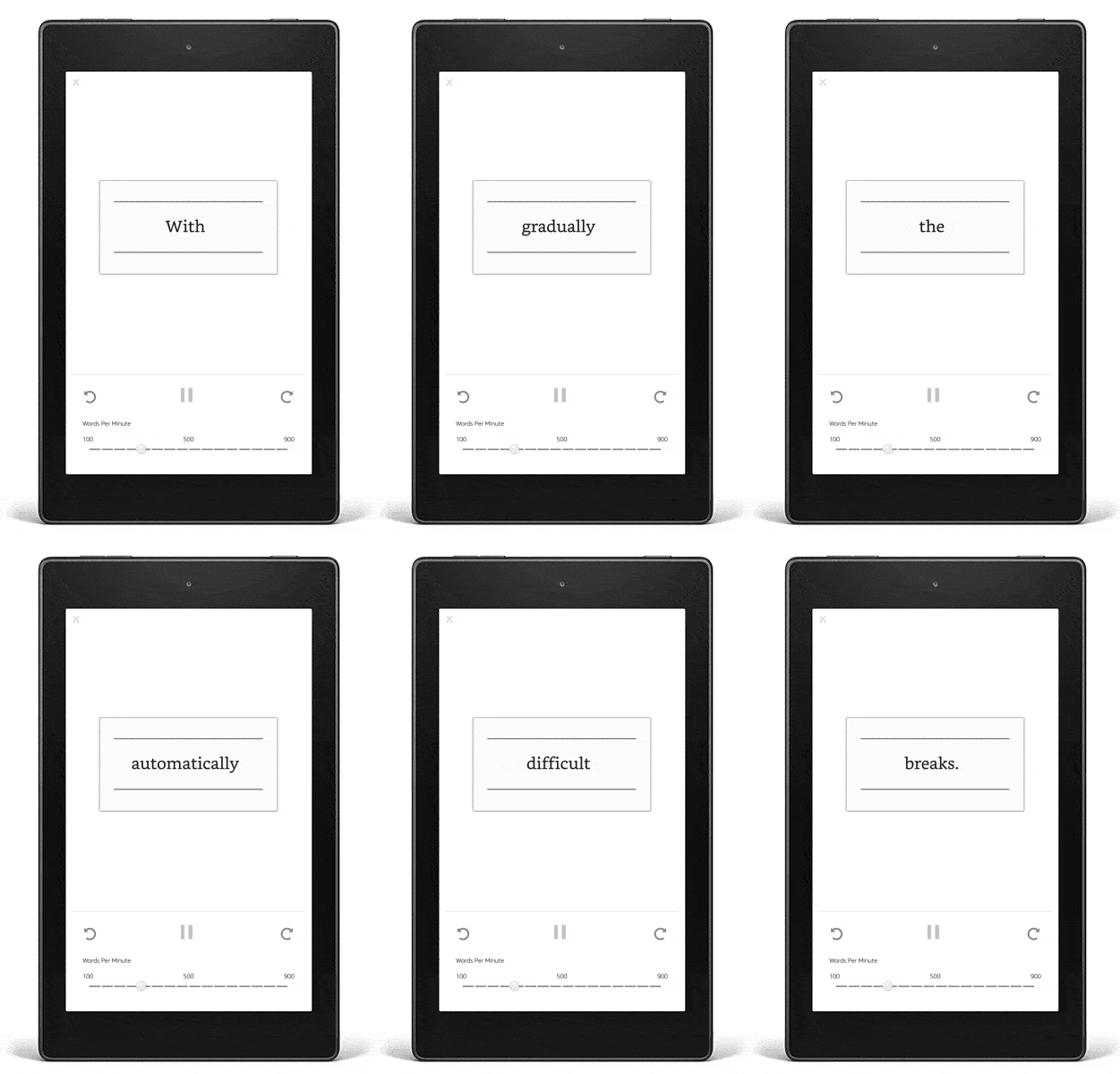
Word Runner is the other tool I find intriguing as a Reading instructor. Notice how in this image on the left the text rolls through one word at a time. Readers can adjust the reading rate up or down. The words are also paced differently with complex words coming up more slowly, and easier words coming up at a faster rate. This pacing is an enhanced form of speed reading technology that is sure to catch on for more than English language learners. I have even enjoyed practicing speeding up my own reading rate. Imagine the possibilities this tool can have in K-12 schools all around the country!

And alas, it is still a Kindle. This tool has Internet, Airplane Mode, Bluetooth, Do Not Disturb, Camera, Help, Auto Rotate, and Settings buttons. The Home page has Silk Browser, Amazon Freetime, Goodreads, Calendar, Photos, Contacts, Docs, Calculator, and many other apps already loaded and included in the low $49 price. Audiobooks, Newsstand, Kindle Books, and other apps can easily be used for all kinds of homework and classroom activities. Maybe Canvas will even decide to add some of these apps.

 For now I will practice learning the capabilities of the Kindle Fire 5th Generation. I am seriously considering asking the college to get a set of these for classroom use for the ENG085 class. Another idea is to have students order one as part of their textbook supplies for the semester. And if any of you have children or grandchildren who may benefit, for $49, it is not a bad investment in their education. Be blessed, and have a great week!

Wednesday, September 30, 2015

Contextualized Writing for First Year Composition

How do we get students to see writing contextualized in their world as a literate activity? We first need to help students see themselves as capable writers. Students must practice using multiple methods of researching and thinking about literate activity in general and writing in particular.

One way some colleges approach this issue is by using modified writing-about-writing curriculum. Teachers can use knowledge domains as ways to explore how and why language matters. For example, students can evaluate Strava comments, Pinterest quotes, Facebook posts, etc. They can then ask themselves, "How do these literacies matter and affect the student's life?"

Another idea for helping students value and interact with writing is to have them create an auto-ethnographic report on themselves and analyze their daily written activities for two weeks. Students can then post their findings into a blog, which adds a visual aspect to the text. Some examples of research methods are as follows:

  • Culture grams: to visualize social selves, literate activities, audiences, and texts
  • Self-observation: to examine textual artifacts and their contextual influences
  • Audience interviews: to gain new insights about textual practices and participation in literate activities through multiple perspectives (interview Pinterest audience member and a member of another social media source or sources.)
Students can ask themselves if the statement "I am what I post" is true. Is what I post upon next influenced by how many comments I received from a previous post? Are we constantly shaping who we are by the feedback we receive? Or are we more driven by internal or other external motivators?

Students can answer questions such as, "What is my purpose for sharing my healthy cooking recipes online? What messages am I trying to convey when sharing Facebook posts involving corruption in the food industry? Why do I share pictures and videos of my family on vacation? What political posts will I share?

I hope you can see how using the world of social media can indeed help students to grapple with written literacies and how these shape their sense of self and the world around them. Next, we can drive them into modes of research by taking the familiar and pressing that knowledge base into the more formalized college system of making meaning with documentation, scholarly articles and literature, and train them to indeed value the world of written academia. And if you have any doubts or wonder how we can make meaning with Math, check out Dataclysm by Christian Rudder. I just heard about this book and hope to read it soon.

Sunday, September 20, 2015

Think Outside the Canvas for Students Sake

What inherent effects do online classes make to the sense of self and empowerment for the average college student? Feminist theorists claim that when we place a course into the online environment, there are consequences. Learning Management Systems such as Canvas tend to heighten instructor presence and flatten student presence. Most online courses primarily function with the student reading what he/she is to do and then turning assignments in for grading. Much less interaction typically takes place between students in the online setting.

In addition, social scientists Fyvbjerg, Landman, and Schram claim it is more difficult to send "ethics of care" or caring messages to students. This situation is labeled phronesis--the kind of knowledge that grows out of intimate familiarity with practice in contextualized settings. You can read more about their research in their book, Real Social Science: Applied Phronesis, Cambridge University Press, New York. 2012.

Because of this research, we need to rethink our current practices in the online environment. It is important to remember that those taking our classes are students, not customers. We need to keep academics at the top of our priority list and not "customer satisfaction." Just this week I had an online FYE103 student tell me that my class had given them the most homework of any online class this semester. I scratched my head, asked my face-to-face class students what they thought, and they similarly scratched their heads. Our teaching practices need to continue striving toward student excellence.

On the other hand, we can embrace phronetic online spaces for teaching. Students can be given spaces to posture individuality and sharing of the self. Blogs, Wikis, Facebook, YouTube, and many other online spaces are available for us to allow creativity. We should work against getting students stuck in the Canvas-only environment when creating assignments.

For example, a few years ago I created space in Ning for students to post their picture, write responses to critical thinking questions, and use multi-media tools to enhance understanding of concepts taught in the course. The students' space was still available semester after semester, and students had access to return and visit with new students along the way. The experience was rich and meaningful. Using external tools does increase grading time to check an outside location, but the rewards were worth it. Ultimately Ning began charging money. Otherwise, I would still have this site up and running.

While exploring likely external tools to build student efficacy, remember that K-12 schools do not have digital literacy outcomes. College students did not have standards for these in the past, so some will know random areas of digital skill based on personal interest and digital access. For this reason, don't introduce new tools without making tutorials available, but be brave and think outside the Canvas.

Saturday, September 19, 2015

Minding the Gap

College is a transitional space for incoming freshmen. Instructors who recognize this gap will do well to create space for students to transition in a safe and comfortable environment. We need to remember that these incoming students do not have the same cultural, economic, academic, or social situation that we maintain. Some are coming with little English-speaking ability. Others come with a lack of familial background in the college environment. These first-generational college students are especially vulnerable to anxiety in the new environment.


I am not sure about your experience, but in these past years I find my classroom shifting from a multi-age population to one that is averaging students of about 19 years of age. We can take advantage of this change and ask students to explore articles relevant to their generation. One English instructor suggested an assignment where students read articles that are negative about millennials and then asking the students to write rebuttals. 

And I know you have heard this before, but it is so important to repeat that these digital natives, although many have strong multi-tasking skills and strong Twitter, Facebook, and texting skills, they may not really know how to use many other tools we would expect. Some struggle with simply asking them to write a paper in Word. Others don't know how to attach a file in email, and be sure to remind them to check their YC email daily!


With the switch to Canvas this fall, we have also made a better choice for students. They are finding the simplicity of this new Learning Management System (LMS) to enhance their ability to download and do the homework we assign on their smartphones, but again, remember that not all students have smartphones. And it is not fair to assume that they do or that they should spend their hard-earned money to buy these, so please take care when creating assignments that you don't expect them to whip out their phone and do your instant survey. Enough said.

Getting back to Canvas, let us be more willing to use the tools inside the LMS once we get comfortable with it. We can embed lots of cool tools to enhance student learning experiences with no cost. We can also encourage students to create blogs like this one outside Canvas. When students do so, they create a space that is permanent, one where they can return and read, share and explore long after the class is over.


And lastly, please encourage any students in your classes who struggle with the new college landscape to take the FYE103 class next semester. This class focuses on helping students navigate the college system, develop study skills, and build self-responsibility, motivation, and self-management skills up front. It is never too late. Please also support the new students with mentoring them whether you officially signed up to be a mentor or not. All of our students, whether first-generation or not, can use a good friend in the faculty or staff of Yavapai College. Blessings as we reach out to help them and build a positive learning environment.

Sunday, November 16, 2014

Reflections 2014

Hi everyone,

In this second year of participation, I found the entries were easier to write and that I developed more practice and comfort with adding graphics and links to the posts. Creating posts is an enriching experience because the practice forces me to stop and think for a few moments about what I do that is working, not working, and what I can share with others that may help them along their path to being a great instructor.

This semester I began by writing about two tools that I enjoy using: the iPhone and the iPad. Then I wrote about one free program, Jing, that I use for Screencast videos for multiple purposes. In this post, I focused on how I use Jing to help English reading students to develop better pronunciation, fluency, and comprehension.

Then I went to a conference. I had taken so many notes at TYCA-West in Mesa, Arizona that I felt compelled to pour back over my notes and share what I had learned. First I presented on the value of going to conferences period and highlighted a little of the keynote speaker's comments as well. Next I moved on to presenting three specific presentations that I felt were beneficial to my colleagues here at the college. Just so you know, I have material to write another entire 9x9x25 left in the notebook, so I may continue to write as I get time.

Concerning the experience as a whole, the gifts are great, but they were less of the reason for writing this year as compared to last year. Yes, Todd did go the extra mile to get me sorbet since I am allergic to milk, and it was very good, and the house plant and books were awesome, and the chocolate cookies were delicious, but seriously, I just enjoy being a part of something bigger where I can share with colleagues and actually go through the process of reflecting upon my own teaching and learning process.

Technically speaking, I really liked the opening page on the 9x9x25 blog where we could click on an individual's name and read just his/her posts. That way I could read all of my English teacher colleagues' posts at once, and then move on and read those from FYE classes, and more. The sad part about this year is that I didn't spend as much time commenting on people's posts or on receiving comments. I am not sure what the difference was, but I felt more like an island this time around.

Still and all, it was a great experience, and I will certainly participate again next year. I wish you all the best as we head into the final weeks of the semester. I will miss you all Friday at the luncheon, but I will be with you in spirit. Have a blessed Thanksgiving, and I look forward to seeing you all at Winter Institute.

Speaking of Winter Institute, I hope many of you will come and participate. I have heard there will be a session on December 8 for Quality Matters. There will be an opening panel discussing the new FYE103 class experience. I have also heard of an opportunity to come listen to people who have participated in the 9x9x25 experience, and that is just a taste of what is to come!

Sincerely,

Tina Luffman

Saturday, November 15, 2014

Changing Mindsets and Motivation for the Basic Writer

Christine Helfers from Mesa Community College presented on the mindset research of Carol Dweck and Patrick Sullivan concerning how it relates to the Basic Writer. Helfers asked, "What would improve student attitudes toward learning while providing interesting content for student reading and writing activities? She encouraged participants to read Carol Dweck's book, Mindset: The new Psychology of Success. She claims that Google Books contains most of the chapters for free for those who don't want to purchase a copy. For those who want to test your mindset, go to Carol Dweck's Web site.

Teachers and students need to learn to hear the fixed and the growth mindset. Then we can recognize we have a choice. Just transforming thinking from "I can't do it," to "I can't do it yet," indicates I can do it. Students need to identify steps or actions toward the growth mindset. Here is the link to Dweck's TED talk titled The Power of Yet. Please view it to learn how the simple word "yet" reframes the situation for students who are still needing to work more to achieve a particular level of achievement. Students learn they are not failures, but that they have a choice to continue on to achieve. Now they can identify a step or action toward success.

Helfers mentioned to us that Habits of Mind and Mindset are similar. After doing a little online research, I found Habits of Mind rubrics for K-12 school systems using Common Core. As a college instructor, please consider what relates to the college classroom and what does not.

In addition to improving student mindset, building motivation for learners is essential. In Helfer's developmental writing classroom, she uses short writing activities and assignments. I believe these are beneficial because success in small assignments build student efficacy. Here are some she suggests:
  • Freewriting
  • Interviews
  • Visual invention work such as creating posters on how to reach goals
  • Discussion questions from Mindset research
  • Chapter questions from reading materials
A way to build even more motivation is in the larger writing projects. Helfers creates essay units developed on themes that encourage positive thinking in the minds of the students. Here are some topics she suggests;
  • Grit mini-essay based based on Angela Duckworth's research: TED Talk
  • Successful person they know after reading or listening to Dweck and doing an analysis paper
  • Career exploration possibilities to help students build toward an ultimate goal.
  • SMART goal setting essay
  • Character sketch of a person who positively influenced you. She suggests people like Malcom Gladwell.


When we comment on student work, she encourages us to incorporate mindset principles into our response practices. Don't just say, "Good work." Be specific. Commend effort, but write what is effective to encourage students where they are doing well, and point out specific areas where improvement is needed.

Later I spent some time meeting with Christine Helfers, I asked her what she uses for a developmental writing textbook. She does not. She uses free sites on the Internet for grammar support. The bulk of her class consists of students writing drafts, and then she edits the drafts and returns them to the students. Students learn best when seeing their own errors in writing and having them identified and having the opportunity to correct these errors.

I was drawn to Helfers' ideas since these relate so well to what I was taught at Northern Arizona University in the Composition training I had in graduate school. We read chapters from Mina Shaugnessy's Errors and Expectations, Peter Elbow's Everyone Can Write, and many others. All in all, I found the presentation very stimulating to challenge me in the way I approach basic writing here at Yavapai College. I encourage you to do the same.

Saturday, November 1, 2014

Collaboration in Your Writing Classroom: Team Projects


At the recent TYCA West Conference in Mesa Arizona, October 2014, Levi Martin from the University of Texas at El Paso presented on "Creating Collaborative Spaces that Empower Students in Collaborative Writing Practices." His presentation was lively and enjoyable. To set the stage for this instructor, he is a doctoral candidate who primarily teaches Technical Writing, Professional Writing, and occasional composition courses for the university.

Martin creates short lessons and places students into small teams to apply the lesson. He first defines collaboration as joint writing to help students understand what the term means in this situation. Then he has students write a team paper on Success Strategies.

Factors to consider when creating these collaborative projects are motivation, time with the team, having the right tools, developing team contracts, and having multiple conferences with the instructor, both team and individual.

Martin bases his team projects on Achievement Goal Theory, Walters, 2004, 236. He believes that higher motivation equals higher achievement. Once students graduate from college, their future professional needs will require collaborative skills in the workplace. Therefore, team work has high applicability and relevance to students.

Martin also states that he doesn't call collaborative writing "group work." He calls it "teamwork," which has a better connotation. Other ideas for names to call this type of collaboration are agencies, partners, think tank. I mentioned that the term "partners" has not always met with a positive connotation in my classroom, and the others seemed to agree.

When creating a writing center for students, he named the tutors "writing consultants." This term similarly gave students more of a desire to go see someone for assistance.

Martin favors increased student involvement. When students have a voice in creating the assignments, this practice creates a deeper understanding of the work and greater sense of ownership. Discussion on the goals of the assignment also opens the conversation to discuss the assignment and its purpose in a more directed, useful environment.

Time with team members is essential. Martin claims that after the initial honeymoon, students need time to work with and get to know one another in non-threatening context, the opportunity to learn strengths and weaknesses of the members, and time for peer review. The instructor is the catalyst. Martin grades the comments peers make on paper, not the draft itself. He gives 20% of the final grade to the comments made on other students drafts and 80% to the student's own final version.

This instructor also uses tools. Martin uses "the Google."
  • Google Drive and Google Docs provide (a)synchronous platforms
    • Instructor can join the conversation in a non-threatening way
    • Students can compose, edit, revise collaboratively without being in the same place
    • All changes and comments are recorded for both students and instructor
  • He also uses color-coded writing. Each student is assigned a different color for text.
  • Presence is key. No matter the software used, the instructor needs to be present.
    • Students need to know the instructor is aware and active in development of the work.
    • Instructor presence develops accountability and builds motivation.
Students develop the contracts for team projects.
  • In conjunction with developing guidelines, students have ownership of the process they use to complete the work.
  • Students develop their own responsibilities, dates, and repercussions.
  • All team members write the contract, which gives exposure to a new genre of writing.
  • Writing the contract increases student awareness of the process and responsibilities.
Both group and individual student conferences are vital to team project development and success. Class time works well for group conferences, according to Martin. He uses office hours for individual one-on-one conferences. The instructor needs to be aware of up-to-date progress on the project. 

Open communication is also vital. Students need to be able to contact the instructor with any issues, questions, and concerns regarding the class.Limit rules to correspondence within reason. Work to get students talking to you. The more comfortable they are, the better questions students ask.

Martin created a Twitter account for his students so they could ask him short questions for quick answers. This type of easy access keeps the instructor from giving out personal contact information. 

If you are interested in developing team projects with your class, I hope you will read through Martin's ideas here and take what works for you. It is my personal opinion that these ideas would work best for second year college students, but team projects can also be used for first year and even developmental classes. I wish you all the best as you challenge yourself to try these team projects with your students. Data shows that classrooms doing project learning activities have higher retention as students get involved with one another and develop accountability.